Crypto market cap leaps $800B in Q3, but spot volume drops 14%

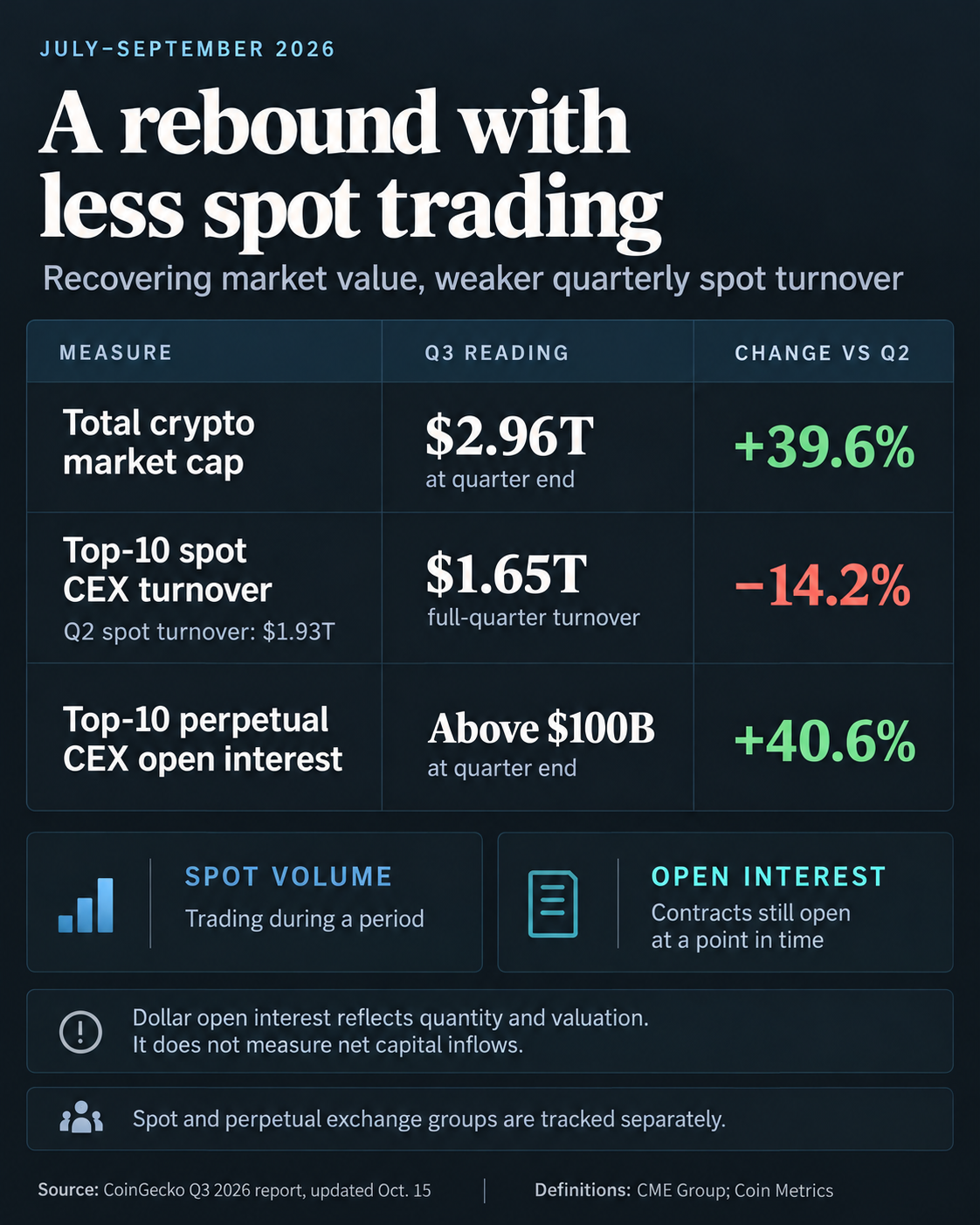
Crypto’s third-quarter rebound in 2026 came with weaker spot trading at major centralized exchanges, even as the dollar value of open perpetual futures positions expanded, according to data provider CoinGecko’s quarterly report.
Total crypto market capitalization gained 39.6% during July through September, finishing at about $2.96 trillion after ending the second quarter near $2.1 trillion. Yet the report’s top-10 spot exchanges handled $1.65 trillion in quarterly turnover, down 14.2% from $1.93 trillion in the second quarter.
Meanwhile, dollar open interest at its top-10 perpetual exchanges rose 40.6% over the third quarter and closed September above $100 billion. Recovering valuations were accompanied by less spot turnover and a larger dollar value of outstanding derivatives contracts.
Binance’s share of the tracked spot market rose from 38.7% in the second quarter to 42.7% in the third quarter as the cohort’s overall turnover contracted. On the perpetual side, KuCoin and Deribit recorded falling open interest despite the aggregate increase.


What the $100 billion measures
Open interest captures contracts that remain open at a particular time. The $1.65 trillion figure covers three months of trading, while the above-$100 billion figure describes exposure remaining at quarter end.
CoinGecko tracks top-10 groups for each market separately, so these totals cannot trace money moving from spot into derivatives.
Perpetual futures have no scheduled expiry, and traders maintain positions by keeping sufficient margin, or collateral. Each contract pairs a buyer with a seller, and the total outstanding value does not identify a net bullish bet or show whether traders are speculating or hedging.
Coin Metrics’ methodology shows how futures notional value combines contract quantity, contract size, and the underlying asset’s reference price. For contracts whose size is measured in coin units, rising prices can lift dollar open interest without an increase in coin quantity.
The effect depends on contract specifications, so the reported 40.6% rise alone cannot establish fresh capital inflows or traders’ leverage ratios.
In CoinGecko’s broader market-wide series, September’s average daily trading volume reached $94.8 billion, compared with $57.7 billion in July. The full-quarter daily average nevertheless fell 8.6% from $73.3 billion in the second quarter.
This series differs from the top-10 spot exchange total, but it shows why an improvement late in the quarter could coexist with a quarterly decline.
For the third quarter, the rebound in valuations outpaced the recovery in trading activity. The larger derivatives total reflects the dollar value of positions left open at September’s end, October’s outstanding exposure requires a newer snapshot.