Switzerland approves landmark Bitcoin ETF after ruling trading volume sufficient

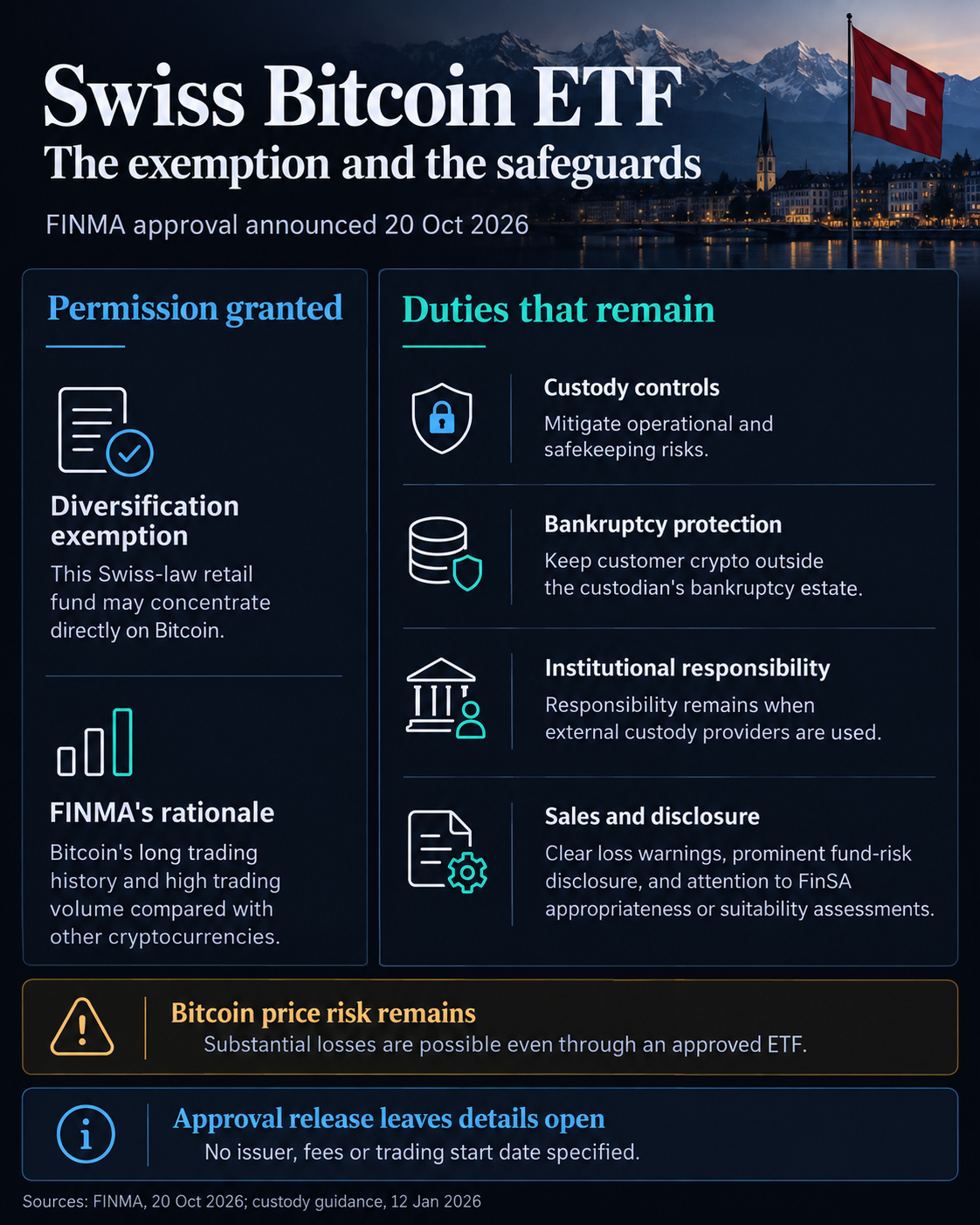
Swiss financial regulator FINMA has approved the first retail exchange-traded fund under Swiss law to invest directly in Bitcoin, granting a diversification exemption that allows concentrated exposure while keeping custody and sales safeguards.
In its Oct. 20 announcement, FINMA said Bitcoin’s long trading history and particularly high trading volume compared with other cryptocurrencies justified the exception. The fund falls into Switzerland’s category of other funds for alternative investments carrying particular risk.
The exemption allows this retail fund to concentrate on Bitcoin without meeting the applicable diversification requirements. FINMA described an exception for this case, giving the fund permission to hold concentrated exposure within that legal structure.
That structure distinguishes it from the exchange-traded products, or ETPs, familiar to Swiss investors. Swiss exchange SIX describes its ETPs as collateralized debt securities, rather than collective investment funds.

A fund investing directly in Bitcoin and a debt security linked to its performance are different legal arrangements, even when both offer Bitcoin exposure.
FINMA’s announcement did not name the fund’s issuer, disclose fees, or provide a trading start date. Approval alone does not establish when investors can trade the product or what it will cost.
The regulator also said other providers had submitted or announced Bitcoin ETF applications, but had not reported further approvals.
Safeguards for Bitcoin ETFs remain around custody and sales
FINMA said supervised institutions must still reduce operational and custody risks, referring to its Jan. 12 custody guidance announcement. The existing guidance calls for technical expertise, robust infrastructure and appropriately monitored providers.
It also calls for clear bankruptcy protections: customers’ crypto assets must remain outside a custodian’s bankruptcy estate. Using an external provider does not shift responsibility away from the authorized financial institution, and these requirements help safeguard the assets.

At the point of sale, FINMA reminded supervised institutions offering crypto-linked instruments to comply with the Swiss Financial Services Act (FinSA). It emphasized clear volatility and loss warnings, alongside particular attention to appropriateness or suitability assessments under the act. Fund documents must also prominently explain the risks.
Those protections address how assets are held, how the investment is explained, and how it is sold. Bitcoin’s market risk remains with the buyer.
FINMA warned that investments can lose substantial value through sharp price swings even when made through an approved ETF, so the diversification exemption carries no protection against a fall in Bitcoin’s price.