US judge kills Milei’s LIBRA memecoin lawsuit, leaving investors stranded
Investors in LIBRA, the memecoin promoted by Argentine President Javier Milei, lost a district-court route to recovering their losses after a US judge dismissed the proposed class action over LIBRA and fellow memecoin M3M3.
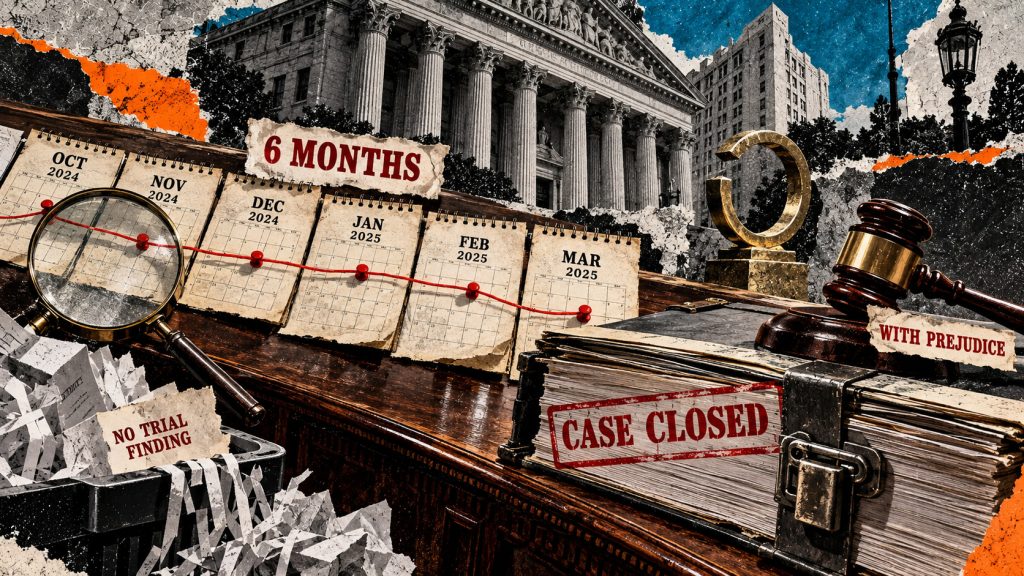
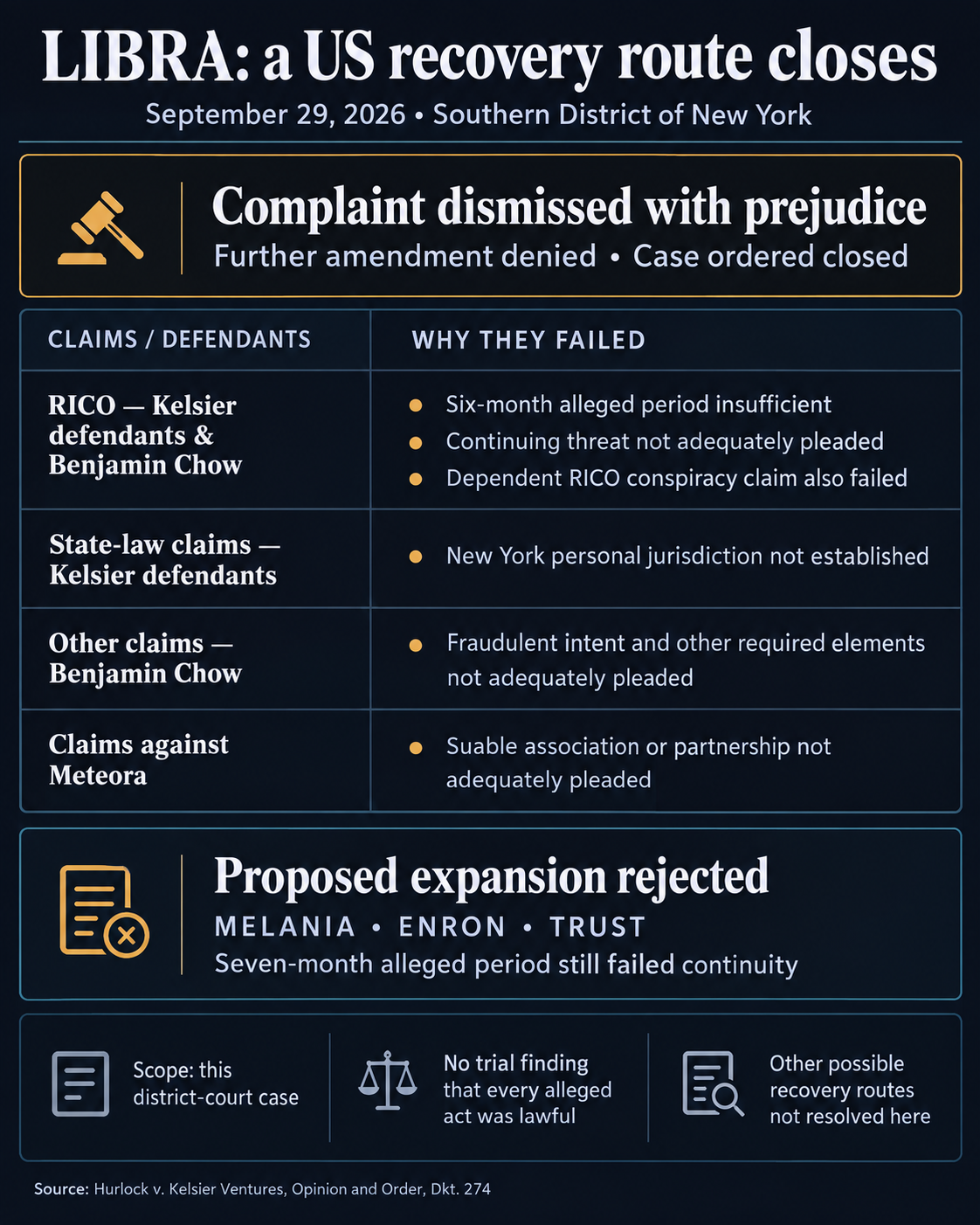
In a Sept. 29 opinion, Judge Jennifer L. Rochon dismissed the amended complaint with prejudice, denied permission to amend it again and ordered the Southern District of New York case closed. The decision also blocked investors’ proposed expansion of the lawsuit to three other tokens.
The plaintiffs alleged that insiders controlled token launches and extracted funds from liquidity pools at outside investors’ expense.
According to the complaint as recounted by the court, LIBRA launched on Feb. 14, 2025, and Milei promoted it before withdrawing his support that day. The dismissal resolved the legal sufficiency of the claims and the court’s jurisdiction.

Why the racketeering claims in the LIBRA case failed
The central federal claim relied on the Racketeer Influenced and Corrupt Organizations Act, or RICO. It requires a pattern of related racketeering acts that either spans a substantial period or threatens continuing criminal activity.
The court found neither form of continuity adequately pleaded against the Kelsier defendants, including Kelsier Ventures and Hayden Davis, and Benjamin Chow, Meteora’s co-founder and former CEO.
For the first route, the court treated the alleged conduct from October 2024 through the March 2025 complaint as a six-month period. Multiple schemes and a potentially large group of victims did not overcome that short duration.
The opinion applied Second Circuit precedent that generally demands a longer period for this form of continuity, while expressly recognizing that two years is not a fixed cutoff. I
The alternative route required facts supporting a continuing threat. The court found that broad assertions about a repeatable token-launch business and referrals to other projects did not establish, defendant by defendant, that alleged wire fraud was a regular business practice. The dependent RICO conspiracy claims failed too.
The proposed amendment would have added MELANIA, ENRON and TRUST, another plaintiff and new defendants. But the judge found it extended the alleged racketeering period to only seven months and provided no facts curing the continuing-threat defect.
After RICO failed, the court dismissed the Kelsier defendants’ remaining state-law claims for lack of personal jurisdiction. Allegations about nationwide social media and crypto infrastructure did not establish the necessary New York connections. The court did not reach the merits of those state-law claims.
The court dismissed all claims against Chow for pleading defects, including insufficient allegations of fraudulent intent. Claims against Meteora failed because investors had not adequately pleaded it as a legal association or partnership capable of being sued.
Hayden Davis’s denied wrongdoing and jurisdiction objections in June 2025. The new ruling turns that earlier dispute into a concrete setback for investors seeking recovery through this action.
The order does not establish that every alleged act was lawful or determine the status of every other possible recovery route.