Grayscale turned more than $1.1 billion of staked crypto into a recurring reward-sale machine for ETF holders

Grayscale has formalized a mandatory minimum cadence for converting staking rewards from three crypto exchange-traded products into cash and paying the net proceeds to shareholders.
Trust amendments executed Aug. 6 for the Grayscale Ethereum Staking ETF (ETHE), Grayscale Solana Staking ETF (GSOL) and Grayscale Avalanche Staking ETF (GAVA) require each product to reduce “Staking Consideration” to cash no less often than quarterly. Net proceeds must then be distributed promptly after applicable fees and trust expenses.
The three trusts currently intend to make distributions monthly, according to Form 8-K filings submitted Aug. 7, but the binding floor is quarterly.
As the trusts receive staking rewards, they must periodically sell that earned consideration and pass the resulting cash to investors. The rule therefore creates a recurring market sell flow for reward tokens.


It does not create scheduled liquidation of the trusts’ principal ETH, SOL or AVAX holdings. The distribution clauses apply to staking consideration earned by the products. Other disclosures still permit token sales for separate purposes, including redemptions, fees and expenses.
The amendments establish that reward tokens will be converted, but not how much will be sold in any future period.
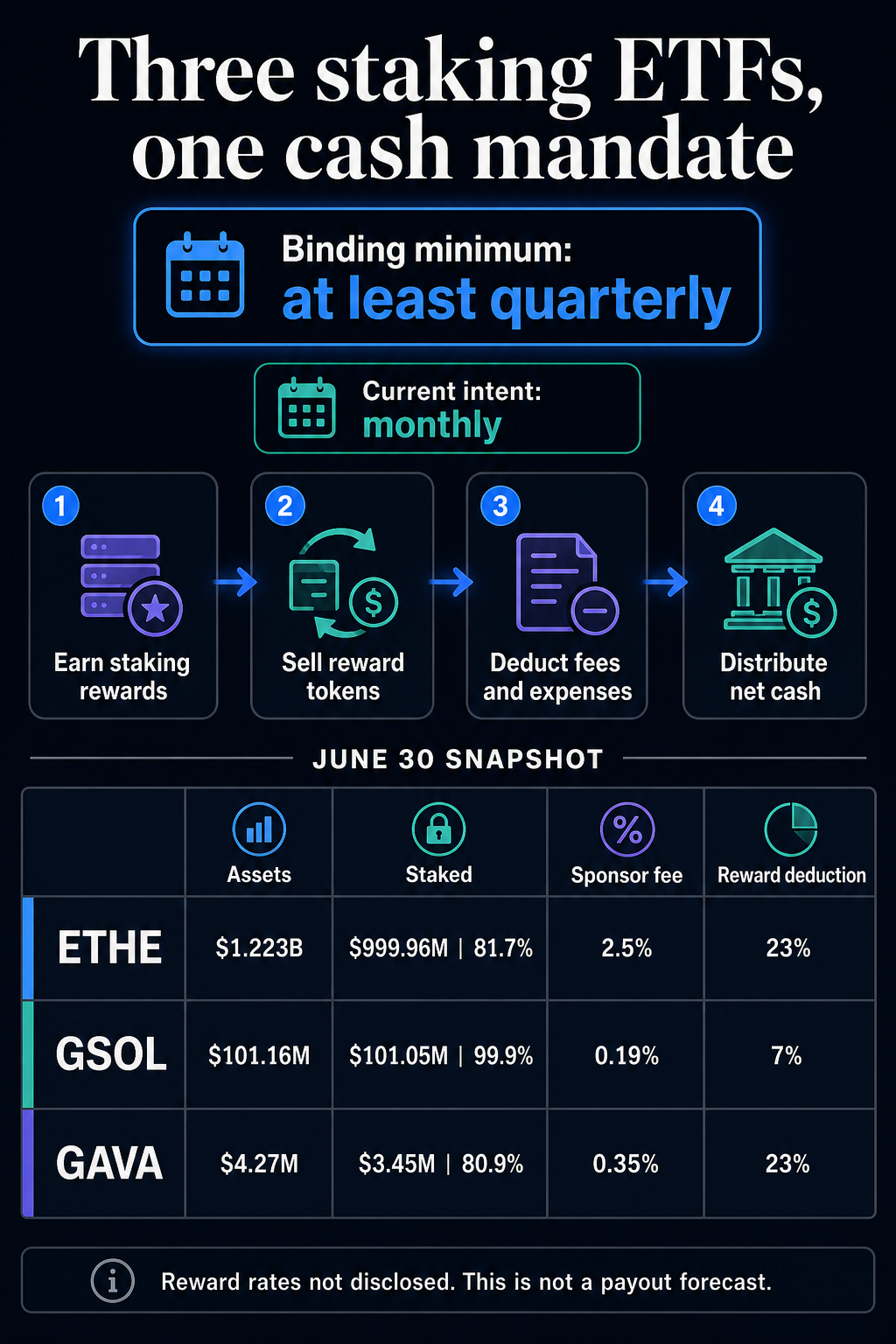
As of June 30, ETHE reported $1.22 billion in total assets and $999.96 million in staked ETH, equivalent to roughly 81.7% of its assets. GSOL reported $101.16 million in assets and $101.05 million of staked SOL, or about 99.9%. GAVA reported $4.27 million in assets and $3.45 million of staked AVAX, or about 80.9%.
The reports do not provide current annualized reward rates. Future sales and payouts will depend on rewards actually received, the amount staked, protocol-level reward rates, token prices, and deductions.
ETHE charged a 2.5% annual Sponsor fee, while its Sponsor staking fee and validator fees together accounted for 23% of gross rewards as of June 30. GAVA disclosed a 0.35% annual Sponsor fee and the same 23% aggregate reward deduction. GSOL disclosed a 0.19% annual Sponsor fee and a 7% aggregate staking-related deduction covering Sponsor and validator fees.
The annual Sponsor fees and the reward deductions use different bases and should not be treated as additive percentages.
ETHE offers an operating precedent without a forecast. The fund paid approximately $9.4 million, or $0.083178 per share, on Jan. 6 after selling staking rewards earned from Oct. 6 through Dec. 31, 2025. Different asset levels, staking participation, fees, reward rates, and token prices make it unsafe to extrapolate that payment across the three products.

Grayscale move creates a tax complexity
The conversion to cash planned by Grayscale may simplify what shareholders receive, but ETHE and GSOL tax disclosures indicate that the underlying activity can create multiple potential tax consequences.
Assuming grantor-trust treatment applies, a US holder is generally treated as receiving a pro rata share of staking income when the trust earns it.
A subsequent trust sale of reward tokens to fund a cash distribution can also allocate a pro rata capital gain or loss to the holder. Under the treatment described in the filings, receiving the cash itself should not be an additional taxable event.
The disclosures caution that the grantor-trust position is not guaranteed. They also flag potential unrelated business taxable income for some tax-exempt holders and unresolved sourcing or withholding questions for non-US investors.
The amendments therefore create a recurring operational loop: earn reward tokens, sell them, and distribute net cash. Its market sell flow will depend on realized rewards and deductions, not headline asset totals alone.